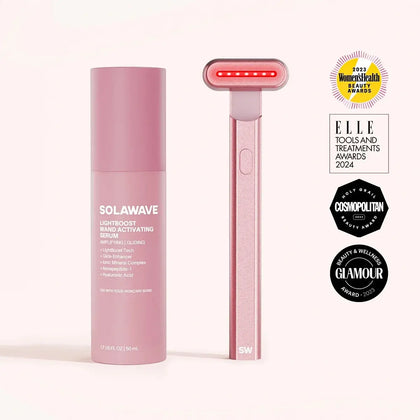
Wand vs mask is the most common red-light-device question, and the honest answer is that they're different tools for different uses — not two versions of the same thing. Here's the breakdown by mechanism, treatment time, precision, price, and the four buying mistakes that make most at-home LED devices underperform regardless of form factor.
The mechanical difference
LED mask
A rigid or flexible face-shaped panel studded with LEDs. You sit or lie down, wear it for 10-20 minutes, the entire face is treated passively simultaneously.
- Treatment mode: passive — you're not doing anything, the mask treats everything under it.
- Session time: 10-20 minutes once, full face.
- Precision: low — LEDs are spaced evenly, not targeted to specific concerns.
- Contact type: non-contact (LEDs sit a few mm from skin).
Red light wand
A handheld device — typically the size of an electric toothbrush or mascara — that you glide over specific facial zones. Treatment is active: you direct the device where you want it.
- Treatment mode: active — you glide it over forehead, nasolabial, jaw, under-eye, one zone at a time.
- Session time: 5 minutes per zone (15-20 min full face if treating every area).
- Precision: high — you focus energy on specific concerns (fine lines, sun spots, etc.).
- Contact type: direct skin contact, which enables additional modalities (microcurrent, warming, massage) that masks can't deliver.
Where the wand outperforms the mask
- Precision. If you have a specific concern (nasolabial folds, 11-lines between brows, crow's feet), a wand lets you focus treatment time on those zones. A mask distributes energy evenly whether you need it on your jaw or not.
- Irradiance at the treatment site. Wands typically deliver higher mW/cm² at the skin surface than masks because they're smaller and the LEDs are closer. 5 minutes on a wand at 100 mW/cm² can equal 15 minutes on a mask at 30 mW/cm².
- Multi-modal treatment. Contact-based wands can add microcurrent (gentle electrical stimulation), warming therapy, and massage simultaneously. Masks can only deliver LED. The Solawave 4-in-1 Wand, for example, combines all four in one pass.
- Targeted neck and décolleté. Masks treat the face only; a wand extends to neck, jawline, and décolleté with no extra device.
- Travel. A wand fits in a travel pouch; a rigid mask doesn't travel well.
Where the mask outperforms the wand
- Hands-free convenience. A mask lets you read, meditate, or scroll — a wand requires your hands for the full session.
- Full-face even treatment. If the goal is general maintenance or mild overall rejuvenation rather than targeting specific lines, masks do the whole face without the user needing to remember every zone.
- Consistency in treatment time. A mask timer does the same 15 minutes every time. With a wand, discipline matters — skipping zones or spending 2 minutes instead of 5 undermines the protocol.
- Lower time barrier for some users. If 'sit still for 15 minutes' is easier than 'glide for 15 minutes with attention,' masks remove friction.
Quick decision rule
- Concerns about specific fine lines or targeted areas → wand
- Concerns about general skin quality / overall maintenance → mask (or wand, either works)
- Want multi-modal treatment (LED + microcurrent + warming) → wand (masks are LED-only)
- Want hands-free → mask
- Need travel-friendly → wand
- Budget constraint, want lowest-cost clinical device → wand (quality wands under $200; comparable masks start at $250-300)
The four buying mistakes
1. Buying on price alone (either direction)
A $40 wand and a $600 wand probably don't deliver the same irradiance. Same for a $50 mask and a $400 mask. At-home LED has hobby-grade devices that meet none of the clinical parameters, and premium devices that do. Price is not a reliable indicator — the wavelength, irradiance, and FDA-clearance are. A $189 FDA-cleared 4-in-1 device (like Solawave) is often better engineered than a $600 novelty device.
2. Not checking the specific wavelength
'Red light' is too vague. The clinical research is on 633nm specifically (and 850nm for near-infrared). Devices that say 'red light therapy' without naming the wavelength may be in the 620-680nm range (adjacent but different) or even broader-spectrum LEDs that dilute the clinical wavelength. Look for '633nm' or 'near-633nm' in the spec.
3. Skipping irradiance specs
Irradiance (mW/cm²) is the energy output per unit area. Clinical protocols typically use 40-200 mW/cm². If a device doesn't publish its irradiance, that's a flag — reputable manufacturers publish. Below 30 mW/cm², treatment times would need to be 30+ minutes to match what a clinical device does in 5.
4. Ignoring FDA clearance
FDA 510(k) clearance as a medical device is a real quality signal. It means the manufacturer submitted safety and efficacy data and FDA cleared the device for its stated indication. Non-cleared devices can be sold (cosmetic, not medical claims), but the 510(k) clearance is a threshold I'd use when picking between two otherwise-similar devices. The Solawave 4-in-1 Wand is an FDA-cleared OTC aesthetic device — verify in the FDA 510(k) database.
Stacking wand and mask (the advanced option)
Some users use both — wand for targeted work on specific areas 3-5× per week, mask for maintenance on the other days or as supplementary longer treatment. This is overkill for most people, but if you have multiple concerns (fine lines + uneven tone + acne-adjacent inflammation), the stack is defensible.
If stacking: don't use both in the same session (skin fatigue isn't a thing at these energies, but it's wasted time). Alternate days.
When an in-office treatment beats both
For severe concerns — deep wrinkles, significant sun damage, scar remodeling, melasma — in-office LED, laser, or microneedling still outperforms home devices. Home LED is maintenance and mild-to-moderate treatment. If you need a bigger intervention, book a dermatologist.
Related reading
- Does red light therapy actually work — what the research says.
- How to use a red light wand correctly.
The Solawave lineup
- 4-in-1 Red Light Therapy Wand Kit — LED + microcurrent + warming + massage.
- Light-Therapy Boosting Wand Activating Serum — conductive pairing serum for the wand.
- Skin Therapy Activating Serum — entry-tier pairing option.
- The full Solawave collection.
References
- Photobiomodulation — clinical practice review — PubMed / Annals of Biomedical Engineering (accessed 2026-04-22)
- Device irradiance and clinical response relationship — peer-reviewed review — PubMed / Photomedicine and Laser Surgery (accessed 2026-04-22)
- FDA 510(k) Premarket Notification Database — US Food and Drug Administration (accessed 2026-04-22)
- American Academy of Dermatology — At-home light-therapy device guidance — American Academy of Dermatology (accessed 2026-04-22)
Discover more from Solawave or browse the full Solawave collection.
Frequently asked
What does "Red Light Wand vs LED Mask: Which One Actually Delivers" cover?
This piece walks through the topic, context, and practical implications laid out in the article body above — focused on giving you a clear, sourced read rather than a quick listicle. Use it to deepen your understanding of the brand, category, or product family discussed.
Who is this article written for?
Readers shopping the brand or category covered, plus curious browsers researching independent makers stocked at Curated Sense. Both casual shoppers and trade buyers will find the same source-linked perspective.
How does Curated Sense vet the brands featured in journal articles?
Every brand in our journal has been onboarded directly: live inventory sync with the brand's own catalog, links back to the maker's own .com, and quality checks against return-rate, fulfillment-time, and customer-message-volume thresholds. We don't run sponsored placements in our journals.
Where can I shop the products discussed in this article?
Open the brand's collection or sub-collection page linked above to see current stock. Each product card opens a full Curated Sense product page with sizing, materials, the maker's own description, and the brand's live shipping policy.