The red-light-therapy research supports a specific protocol — 5 minutes per area, 3-5 times per week, 8-12 weeks before judging. Most at-home users violate at least two of those conditions and conclude the device doesn't work. Here's the complete protocol: skin prep, serum choice (critical), technique, schedule, and how to track whether your 8-12 week window is actually delivering.
Before you start: skin prep
The wand works best on freshly-cleansed, lightly-damp skin. The sequence matters:
- Cleanse. Use a gentle gel or cream cleanser. Rinse, pat dry. Skin should be free of residue but not bone-dry.
- Skip toner on wand days. Some toners leave a conductive-unfriendly residue or strip too much surface moisture. If you love your toner, use it on non-wand days.
- Do NOT apply: retinoid, exfoliating acids (AHA/BHA), heavy oils, or thick moisturizer before the wand. These interfere with microcurrent conductivity or create friction.
- Skin should be damp, not wet. Wet creates puddles that disperse energy unpredictably. Damp-to-matte is the target.
Serum choice — the critical step
This is where most people go wrong. A red light wand with microcurrent requires a conductive serum. Using a random moisturizer or oil-based product breaks the protocol:
- Water-based, conductive serums — these are what you want. Peptide-rich water-based serums conduct microcurrent cleanly and have enough slip for the wand to glide.
- Hyaluronic-acid serums — acceptable. Conductive (water-based), but less peptide content, so you're not getting the full treatment-time benefit.
- Oil-based serums or face oils — do NOT use. Oil is non-conductive; the microcurrent won't flow, and the wand will drag and skip.
- Thick creams or balms — do NOT use. Too much friction, and they coat the LED output.
- Nothing at all (dry skin) — do NOT use. The wand needs a conductive medium to deliver microcurrent, and dry skin causes friction on the device.
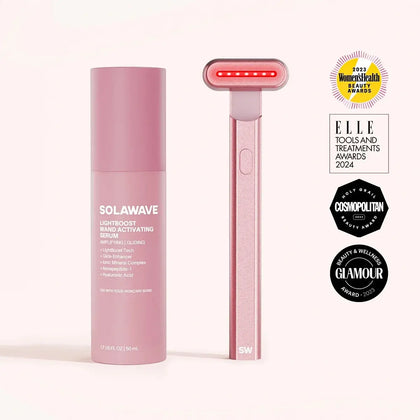
This is why Solawave sells a Light-Therapy Activating Serum — it was engineered to partner with the wand. Conductive, slippery, peptide-rich, designed for 5-minute treatment-time use. If you want the full clinical protocol, use the partner serum. If you want to improvise, a water-based peptide or hyaluronic-acid serum is the minimum viable substitute.
The 5-minute-per-zone protocol
Solawave's published clinical protocol is 5 minutes per face zone, with one zone at a time. The zones:
- Forehead + 11-lines (between brows). Glide horizontally across forehead, then vertical strokes between the brows. 5 minutes.
- Under-eye + crow's feet. Very gentle strokes under the eye, outward toward the temples. Do NOT press hard on the eye area. 5 minutes.
- Nasolabial folds. Upward and outward strokes from the corner of the mouth to the cheekbone. 5 minutes.
- Jawline. Along the jaw from chin to ear. 5 minutes.
Full-face session: 20 minutes. Partial-face (alternating days): 5-10 minutes on the zone you're focusing on.
Technique details most tutorials skip
- Pressure: light, consistent. You shouldn't be pressing the wand into your skin — it glides over the surface. Pressure creates friction and distorts the LED contact.
- Angle: the LED face of the wand should be flat against skin for maximum energy delivery. A tilted angle means only part of the LED is touching.
- Direction: upward and outward on the face — following the natural lymph-drainage direction. Avoid downward strokes.
- Speed: slow and steady. Fast passes reduce energy delivered per square cm. About 2-3 cm per second is a good pace.
- Overlap: each pass should overlap the previous by 50% to ensure even coverage.
- Re-apply serum if it absorbs: If you feel the wand starting to drag 2-3 minutes in, add another pump of serum. The skin may have absorbed the initial layer.
Schedule — the three that work, and the one that doesn't
Schedule A: Full-face, 3× per week (most common)
- Monday, Wednesday, Friday — 20-minute full-face session each.
- Tuesday, Thursday, weekend — skin recovery days (topical retinoid or vitamin C fine on these days).
Schedule B: Zone-rotation, 5-6× per week (advanced)
- Mon: forehead (5 min) + nasolabial (5 min)
- Tue: under-eye (5 min) + jawline (5 min)
- Wed: full-face (20 min)
- Thu: forehead + nasolabial
- Fri: under-eye + jawline
- Weekend: off
Schedule C: Daily maintenance (after initial 12 weeks)
- 5-10 minutes daily on whatever zone feels the most needed.
- This is the maintenance phase — after you've completed the initial 8-12 week protocol and seen results, you're maintaining.
Schedule that doesn't work
- Once a week. Not enough frequency for compounding effect. Published research uses 3-5 sessions per week minimum.
- 30-minute sessions twice a week. Sounds like the math balances, but longer individual sessions don't compensate for lower frequency. Frequency matters more than session length.
- Every day for 14 days, then stop. Compressing a 12-week protocol into 2 weeks doesn't work — skin cellular turnover happens on its own schedule.
The four mistakes that waste your 8-12 week window
1. Using the wrong serum
Covered above. Water-based conductive serum = required. Oil-based serum = microcurrent doesn't flow.
2. Inconsistent sessions
Red light therapy compounds. Doing 3 weeks, then skipping 2, then doing 2 weeks doesn't work the same as 8 consistent weeks. If you can't commit to 3-5 sessions per week, wait until you can.
3. Judging at week 2
The peer-reviewed research literature says first visible results show at 6-8 weeks for most users. Judging the device at week 2 gives you no information. If you're worried about whether it's working at week 3, you're looking too early.
4. Skipping the rest of skincare
Red light is a complement, not a replacement. Daily SPF, topical retinoid, vitamin C, and hydration all still matter. Red light stacks on top of a good skincare routine — it doesn't replace one.
How to track whether it's working
Objective tracking makes the difference between 'I think it's working' and 'I know it's working':
- Baseline photos. Day 1, take a face photo in natural morning light, no makeup, no expression. Same angle, same light.
- Week-4 photo. Same conditions. Save both.
- Week-8 photo. Compare to day 1.
- Week-12 photo. This is the real assessment point.
Subjective tracking: keep notes on texture, how makeup sits, whether fine lines are softer when unexpressed. These compound signals are what you'll actually notice day-to-day.
Post-treatment care
- Immediately after: moisturize. The Pre- & Probiotic Nourishing Moisturizer seals in the treatment-time actives.
- Within 30 minutes: apply SPF if it's day-time. Treated skin is in a cellular response phase — daily SPF remains essential.
- Evening treatment: follow with retinoid if you use one (retinoid + red light is a well-documented combination).
Related reading
- Does red light therapy actually work — what the research says.
- Red light wand vs LED mask — which one delivers.
The Solawave lineup
- 4-in-1 Red Light Therapy Wand Kit — the flagship, includes the paired activating serum.
- Light-Therapy Boosting Wand Activating Serum — conductive pairing serum.
- Pre- & Probiotic Nourishing Moisturizer — post-treatment seal-in.
- The full Solawave collection.
References
- Photobiomodulation clinical treatment protocols — peer-reviewed review — PubMed / Annals of Biomedical Engineering (accessed 2026-04-22)
- LED light therapy frequency and dose response — clinical study — PubMed / Seminars in Cutaneous Medicine and Surgery (accessed 2026-04-22)
- American Academy of Dermatology — At-home skincare device guidance — American Academy of Dermatology (accessed 2026-04-22)
- Microcurrent therapy in skincare — dermatology review — PubMed / Journal of Cosmetic and Laser Therapy (accessed 2026-04-22)
Discover more from Solawave or browse the full Solawave collection.
Frequently asked
What does "How to Use a Red Light Wand Correctly (So It Actually Works)" cover?
This piece walks through the topic, context, and practical implications laid out in the article body above — focused on giving you a clear, sourced read rather than a quick listicle. Use it to deepen your understanding of the brand, category, or product family discussed.
Who is this article written for?
Readers shopping the brand or category covered, plus curious browsers researching independent makers stocked at Curated Sense. Both casual shoppers and trade buyers will find the same source-linked perspective.
How does Curated Sense vet the brands featured in journal articles?
Every brand in our journal has been onboarded directly: live inventory sync with the brand's own catalog, links back to the maker's own .com, and quality checks against return-rate, fulfillment-time, and customer-message-volume thresholds. We don't run sponsored placements in our journals.
Where can I shop the products discussed in this article?
Open the brand's collection or sub-collection page linked above to see current stock. Each product card opens a full Curated Sense product page with sizing, materials, the maker's own description, and the brand's live shipping policy.