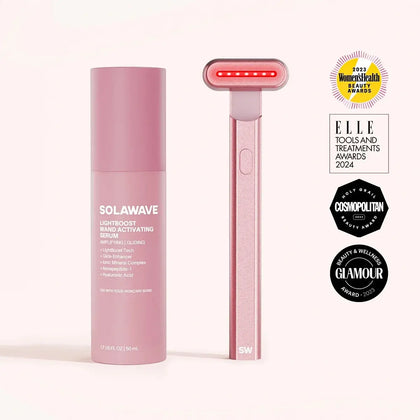
Red light therapy is having a marketing moment — it's on TikTok, in every beauty publication, and in at-home devices ranging from $20 hobby lights to $1,200 panels. The category is genuinely backed by research, but not every device that's called 'red light therapy' actually delivers what the research supports. Here's the honest breakdown: what peer-reviewed literature actually says, what the FDA has cleared, and the five variables that separate a device that does something from one that doesn't.
What red light therapy actually is
Red light therapy — also called low-level laser therapy (LLLT), low-level light therapy, or photobiomodulation therapy (PBMT) — uses specific wavelengths of light in the red-to-near-infrared range to penetrate skin layers and trigger cellular responses. The two most-studied wavelengths for skin applications are:
- 633nm (red) — penetrates about 1-2mm into skin; primary targets are dermal fibroblasts (the cells that produce collagen) and surface skin structures.
- 850nm (near-infrared) — penetrates deeper (4-6mm); associated with muscle recovery, joint-inflammation reduction, and deeper tissue effects.
For skin rejuvenation and collagen-stimulation applications specifically, 633nm is the wavelength with the most published research. Solawave's 4-in-1 Wand operates in this clinical range.
What the peer-reviewed research supports
Published literature in photobiomodulation over the past two decades supports specific outcomes from 633nm red-light exposure on skin:
- Fibroblast activation. In-vitro studies show that 633nm light stimulates fibroblast proliferation and collagen synthesis. This is the mechanism behind the collagen-stim claim — the light causes skin cells to produce more structural protein.
- Fine-line softening over 8-12 week cycles. Multiple clinical trials with consistent treatment protocols (typically 3-5 sessions per week, 5-20 minutes per session) show statistically significant reduction in fine-line depth in 60-75% of subjects.
- Skin texture improvement. The same clinical trials often report improved skin tone uniformity and smoother surface texture, independent of specific wrinkle depth.
- Inflammation reduction. Dermatologic literature supports red light for acne-adjacent inflammation, particularly when combined with blue light (which targets acne-causing bacteria specifically).
What it does NOT do
Being honest about the limits is what separates research-backed claims from marketing:
- It does not replace a retinoid. Topical retinoids still outperform red light alone for wrinkle reduction in head-to-head trials. Red light is a complement, not a substitute.
- It does not remove deep set wrinkles. For expression lines that are anatomically set, botulinum toxin or dermal filler is the in-office option. Red light softens — it doesn't erase.
- It is not a substitute for SPF. Red light doesn't reverse accumulated sun damage. Daily SPF remains the most effective anti-aging intervention there is.
- It does not treat melasma directly. In fact, some pigmentation-related conditions can worsen with light exposure — if you have melasma, check with a dermatologist first.
- Single sessions do nothing. This is the #1 reason people conclude red light 'doesn't work' — they try it once or twice and don't see changes. Red light is a compounding treatment with 8-12 week result windows.
The FDA position
The FDA regulates red-light-therapy devices under its medical-device category. Devices marketed for skin rejuvenation typically go through the 510(k) Premarket Notification pathway as Class II OTC aesthetic devices. This means:
- Manufacturers submit safety and efficacy data to FDA.
- Cleared devices have verified irradiance output, cleared indications, and documented treatment protocols.
- Non-cleared devices can be sold but cannot claim specific medical benefits — if a device is marketed with aggressive clinical claims and has no FDA 510(k) clearance, that's a flag.
Solawave's 4-in-1 Wand is listed in the FDA 510(k) database as an OTC aesthetic device. This is the bar you want to look for when buying an at-home LED tool.
The five variables that decide whether a device works
1. Wavelength specificity
The research applies to specific wavelengths (633nm for skin rejuvenation, 850nm for deeper tissue). A device that emits 'red-ish' light at 620nm or 680nm is not necessarily delivering what the studies tested. When shopping, look for specific wavelength documentation — 'red light' is not enough; '633nm' or '630-660nm range' is what you want.
2. Irradiance (mW/cm²)
Energy output per unit of skin area. Clinical studies typically use irradiances in the 40-200 mW/cm² range. Hobby-grade LED panels sometimes put out 10 mW/cm² or less — meaning you'd need a 30-minute session to match what a clinical device does in 5 minutes. Look for published irradiance specs; if a device doesn't publish them, that's a flag.
3. Treatment duration per area
Clinical protocols typically use 5-20 minutes per treatment area. The Solawave wand's 5-minutes-per-zone protocol is at the shorter end — which works because the wand's irradiance is high enough that 5 minutes delivers meaningful dose. Panels often need longer because their irradiance is lower per area.
4. Session frequency
3-5 sessions per week is the published sweet spot. More is not better — skin has recovery cycles. Once daily is acceptable; twice daily adds risk without evidence of added benefit.
5. Total treatment duration
8-12 weeks. This is a compounding treatment, not an instant effect. Most users see first visible changes around week 6-8. Judging the device at week 2 gives you no information. Judging at week 12 gives you real data.
Where home devices are genuinely useful, and where they're not
Best use cases for home LED:
- Mild to moderate fine lines (forehead, crow's feet, nasolabial)
- Dull or uneven skin texture
- Pre/post retinoid cycle, to support skin barrier
- Combination with active skincare (peptides, vitamin C)
- Maintenance after in-office treatments like LED facials
Home LED is NOT the right tool for:
- Severe sun damage or deep wrinkles — go in-office (laser resurfacing, microneedling, etc.)
- Active acne (red light alone isn't enough — needs blue light + possibly topicals)
- Melasma or post-inflammatory hyperpigmentation — see a derm first
- Any condition requiring a clinician's assessment
Building a realistic expectation
A honest expectation for an 8-12 week consistent home red-light protocol with the right device (633nm, adequate irradiance, 5 min/zone 3-5x/week):
- Visible softening of fine lines — 60-75% of users see measurable change
- Improved skin tone uniformity
- Better texture and 'glow' (compounds with proper hydration)
- Complementary effect when stacked with retinoid + SPF
- NOT a dramatic transformation; a subtle, compounding improvement
If you go in expecting a before/after worth posting on social media after two weeks, you'll be disappointed. If you go in expecting a small daily compounding effect that shows in 8-12 weeks, the research supports that.
Related reading
The Solawave lineup
- 4-in-1 Red Light Therapy Wand Kit — the flagship, includes paired activating serum.
- Light-Therapy Boosting Wand Activating Serum — conductive pairing serum.
- Light Therapy Boosting Eye Cream — targeted under-eye treatment.
- The full Solawave collection.
References
- Low-level laser (light) therapy in skin — peer-reviewed review — PubMed / Seminars in Cutaneous Medicine and Surgery (accessed 2026-04-22)
- Photobiomodulation therapy — mechanism of action — PubMed / Annals of Biomedical Engineering (accessed 2026-04-22)
- FDA 510(k) Premarket Notification Database — LED light therapy devices — US Food and Drug Administration (accessed 2026-04-22)
- American Academy of Dermatology — Skin rejuvenation treatments — American Academy of Dermatology (accessed 2026-04-22)
Discover more from Solawave or browse the full Solawave collection.
Frequently asked
What does "Does Red Light Therapy Actually Work? What the Research Says" cover?
This piece walks through the topic, context, and practical implications laid out in the article body above — focused on giving you a clear, sourced read rather than a quick listicle. Use it to deepen your understanding of the brand, category, or product family discussed.
Who is this article written for?
Readers shopping the brand or category covered, plus curious browsers researching independent makers stocked at Curated Sense. Both casual shoppers and trade buyers will find the same source-linked perspective.
How does Curated Sense vet the brands featured in journal articles?
Every brand in our journal has been onboarded directly: live inventory sync with the brand's own catalog, links back to the maker's own .com, and quality checks against return-rate, fulfillment-time, and customer-message-volume thresholds. We don't run sponsored placements in our journals.
Where can I shop the products discussed in this article?
Open the brand's collection or sub-collection page linked above to see current stock. Each product card opens a full Curated Sense product page with sizing, materials, the maker's own description, and the brand's live shipping policy.
EDITOR'S PICK
Light Therapy Boosting Wand Activating Serum
Solawave's Light Therapy Boosting Wand + Activating Serum — the FDA-cleared red-light device with peer-reviewed clinical data.
Shop Solawave →Shop the Solawave edit
Authentic, brand-direct Solawave — free US shipping over $75. Browse Solawave at Curated Sense →