
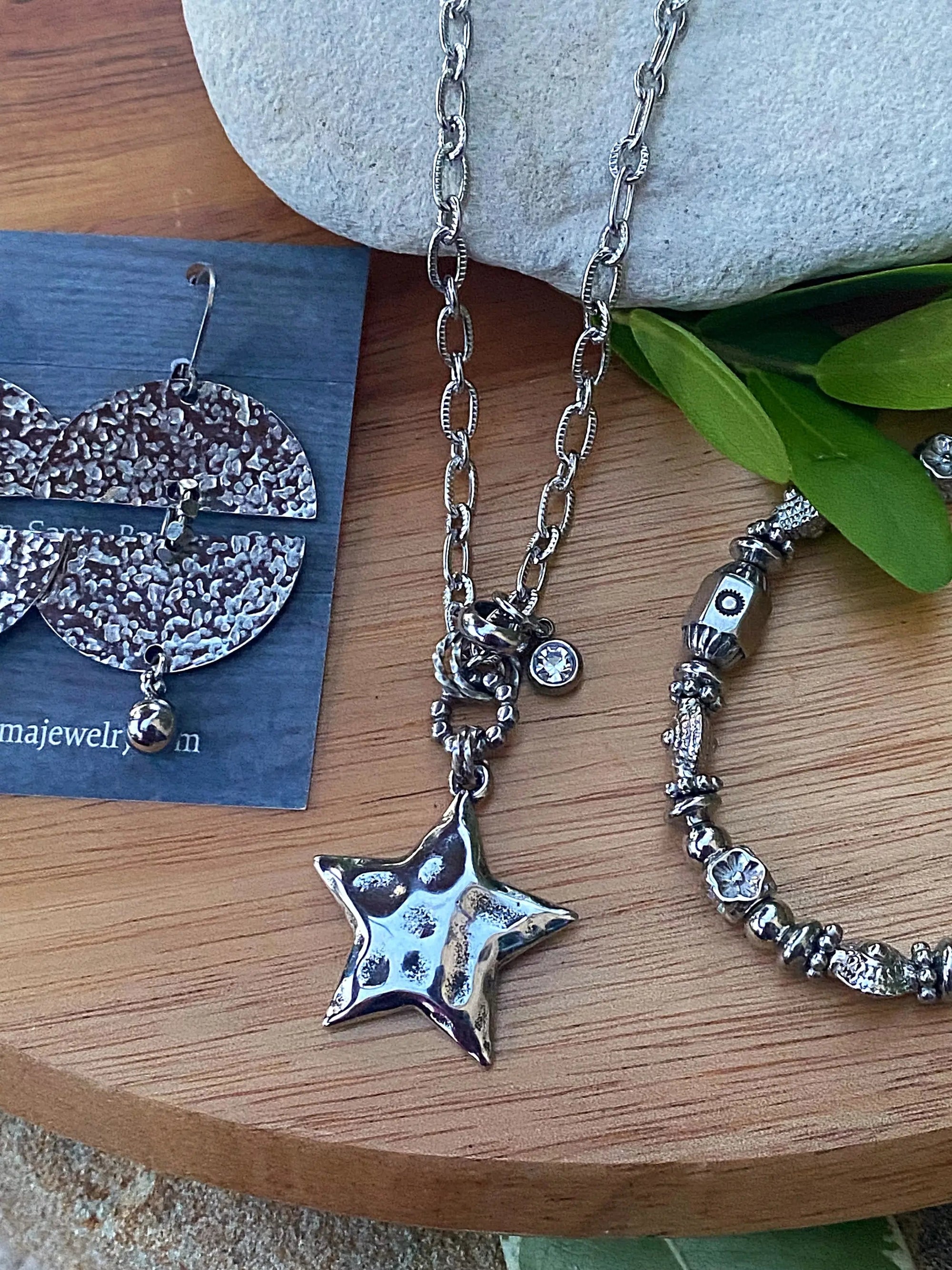
Most fashion jewelry under $40 is plated copper or zinc that flakes within 12 months. The next price tier up is dominated by three metals — stainless steel, sterling silver, gold fill. Each has a use case. Here's how to read the label.
Stainless steel: the workhorse
Marine-grade stainless steel (typically 304 or 316L) is corrosion-resistant, tarnish-resistant, hypoallergenic for most wearers, and structurally permanent. It survives showers, swimming, sweat, and lotion. The downside: it's heavier than sterling, has a slightly cooler/grayer color, and most fine jewelers don't work with it.
Bellaforma uses 316L stainless steel for chains, clasps, ear posts, and jump rings — the structural elements that have to survive years of daily wear. The brand pairs stainless components with sterling, gold-fill, or natural-stone decorative elements depending on the piece. The product page lists which metals are where.
Sterling silver: the reference standard
Sterling silver is 92.5% pure silver and 7.5% copper (the alloy adds structural strength — pure silver is too soft for jewelry). It's hypoallergenic for nearly everyone, takes engraving and stamping well, and develops a soft patina over years that many people prefer to a fresh-polished look. The downside: it tarnishes (oxidizes black) when exposed to humidity, sulfur, or skin oils — sterling needs occasional polishing.
The 'sterling' stamp (.925, STG, or '925') is FTC-required for any item sold as sterling in the US. Watch for 'silver-plated' or 'silver-tone' on the label — those are different (plated copper or nickel under a thin silver layer, fails fast).
Gold fill: the long-term gold alternative
Gold fill is a thick layer of solid 14k gold (typically 5% of the total weight, vs <0.05% in gold plate) mechanically bonded to a brass or copper core. It looks identical to solid 14k, costs roughly 1/15th as much, and lasts 10–30 years before any base metal shows through. Goldsmiths consider it the most cost-effective gold option for everyday-wear jewelry.
Watch for the distinction: 'gold fill' or 'gold-filled' (the real thing, FTC-regulated) vs 'gold plate' (very thin, fails in 1–3 years) vs 'gold tone' (no gold at all, just colored finish). The label difference is enormous; the price tag should reflect it. Bellaforma uses 14k gold-fill where flagged on the product page.
What to actually buy
- Daily-wear, structural (chain, clasp, ear post): stainless steel — won't fail, won't tarnish
- Pendant or focal piece you want to last 50 years: sterling silver or 14k gold-fill — both heirloom-eligible
- Special-occasion or statement piece: sterling silver — more design flexibility, takes engraving
- You're allergic to nickel: stainless steel (specifically 316L) or gold-fill on a copper core (avoid brass-core gold-fill)
- You shower/swim/sweat in your jewelry: stainless steel only — sterling tarnishes faster, gold-fill wears through faster
- You want to engrave it: sterling silver — easiest material to deep-engrave
What to avoid
Anything labeled 'gold tone,' 'silver tone,' 'fashion plated,' or just 'metal alloy' without specifics — these usually mean nickel-plated zinc or copper, which fails in 6–18 months and turns skin green. The actual metal cost on these is pennies; the price tag is design markup, not material value.
Also avoid 'gold vermeil' for daily wear — vermeil is gold over sterling silver (better than gold-plate, worse than gold-fill), but the gold layer is still thin enough that it wears through in 2–5 years on bracelets and rings (more friction). Pendants in vermeil are fine; bracelets are not.
Sources & citations
- Federal Trade Commission. "Guides for the Jewelry, Precious Metals, and Pewter Industries" (16 CFR Part 23). ftc.gov/legal-library/browse/rules/jewelry-guides
- Manufacturing Jewelers and Suppliers of America. "Materials Guide for Handcrafted Jewelry." mjsainc.com
- GIA (Gemological Institute of America). "Metal Allergies in Jewelry." gia.edu
- ASTM International Standard B488 — gold and gold-fill specification.
Frequently asked
What does "Stainless Steel vs Sterling Silver vs Gold Fill: A Jewelry Metals Buyer's Guide" cover?
This piece walks through the topic, context, and practical implications laid out in the article body above — focused on giving you a clear, sourced read rather than a quick listicle. Use it to deepen your understanding of the brand, category, or product family discussed.
Who is this article written for?
Readers shopping the brand or category covered, plus curious browsers researching independent makers stocked at Curated Sense. Both casual shoppers and trade buyers will find the same source-linked perspective.
How does Curated Sense vet the brands featured in journal articles?
Every brand in our journal has been onboarded directly: live inventory sync with the brand's own catalog, links back to the maker's own .com, and quality checks against return-rate, fulfillment-time, and customer-message-volume thresholds. We don't run sponsored placements in our journals.
Where can I shop the products discussed in this article?
Open the brand's collection or sub-collection page linked above to see current stock. Each product card opens a full Curated Sense product page with sizing, materials, the maker's own description, and the brand's live shipping policy.

