
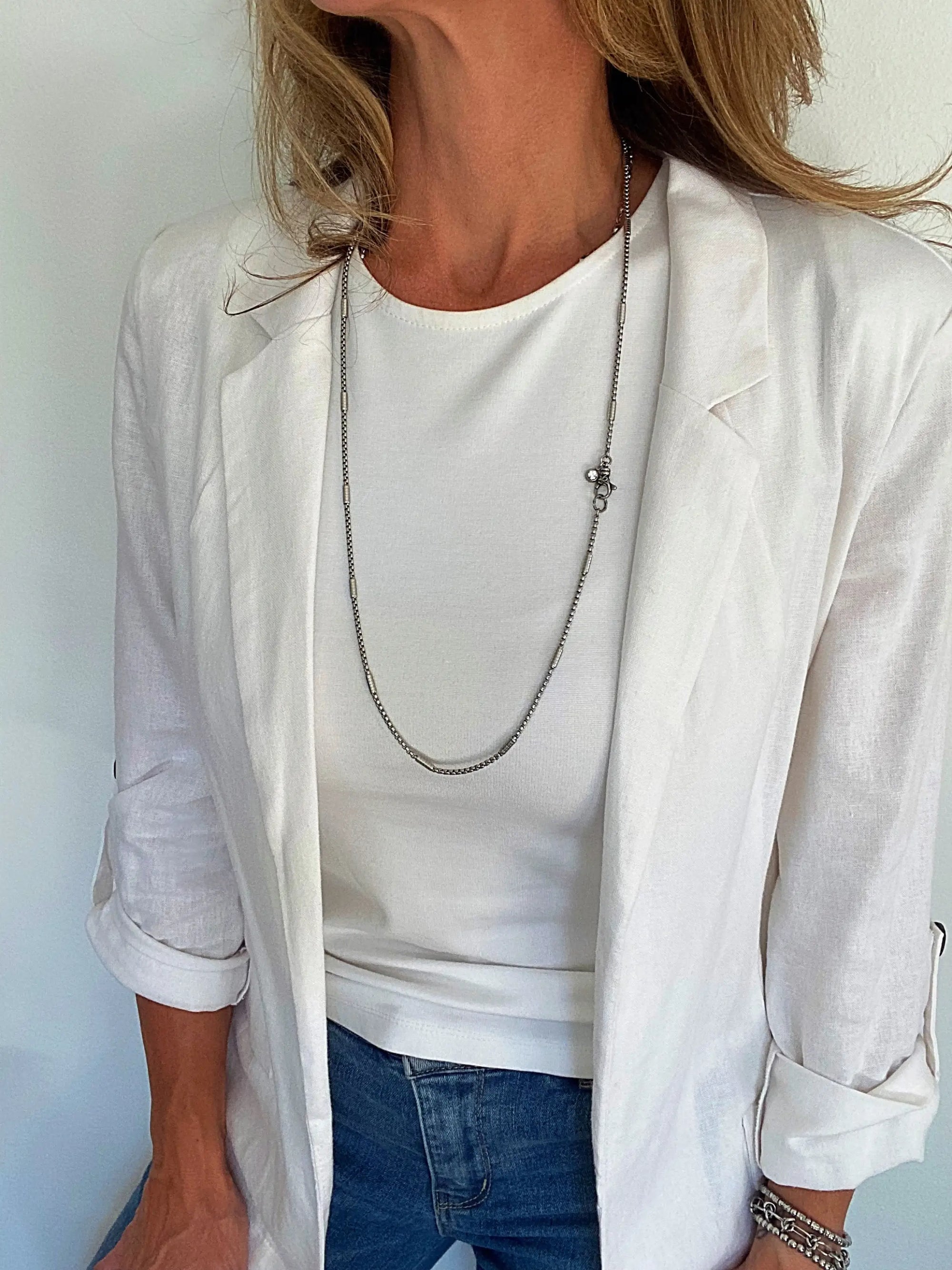
You can buy a 'silver hoop earring' on Amazon for $8 and a visually-identical one from a Santa Barbara handcraft studio for $48. The price gap looks irrational. Here's what the $40 difference is actually buying you.
Metal weight and content
The first difference is structural. A mass-produced 'silver hoop' is typically 0.4–0.8 grams of silver-plated brass or copper — most of the weight is base metal with a 0.5-micron silver layer that wears through in 6–18 months. A handcrafted equivalent in solid sterling is typically 1.8–3.2 grams of 92.5% silver — 4–8x more silver by weight.
Cost per gram of silver in 2026 is around $1.05 wholesale. So the materials cost difference between the two earrings is around $2–3. The remaining $35-ish in price difference is the cost of (1) labor, (2) small-batch production overhead, and (3) the structural construction described next.
Construction tolerance
Mass-produced jewelry uses CAD-designed parts manufactured by injection-molding or stamping at micron-scale tolerance — but the assembly is often glue-and-snap, where parts are bonded together with industrial adhesive (typically epoxy or cyanoacrylate). Glue fails. Most mass-produced jewelry has a glue-failure point at 200–400 stress cycles.
Handcrafted jewelry uses soldered, knotted, or wire-wrapped construction — same metal joining the same metal at every connection. There's no glue to fail. The connection points are as durable as the metal itself. A soldered sterling silver loop survives ~100,000 stress cycles; a glued one survives 200–400.
Repairability
When mass-produced jewelry fails — and it does, usually within 18 months — it's almost always non-repairable. The base metal underneath the silver plate is usually wrong for soldering (plated brass/copper combinations melt unevenly), and the structural design assumes glue-bond rather than metal-bond.
Handcrafted jewelry can be repaired indefinitely. A jeweler can re-solder a snapped sterling chain, replace a worn ear post, re-string beaded pieces, polish out scratches, even resize rings. The lifecycle math is different: a $48 handcrafted piece that lasts 30 years and goes through 3 repairs (~$80 total) costs you $128/30yr = $4.27/year. A $8 mass-produced piece replaced 20 times in the same period costs $160/30yr = $5.33/year.
What you're actually paying for
The price gap between handcrafted and mass-produced isn't a luxury markup — it's a different product category entirely. You're paying for: (1) materials worth keeping, (2) construction designed to last, (3) a piece that's repairable when something does fail, and (4) the labor of the person who actually built it.
The harder-to-quantify factor is what mass-produced jewelry is actually optimized for: the photograph. Cheap jewelry photographs well at the moment it's listed, then degrades within a year. Handcrafted jewelry often photographs less dramatically (no hyper-polished perfection) but ages well — develops patina, softens at the edges, becomes recognizable rather than just present.
You're not buying jewelry. You're buying time — how long the piece is yours before it isn't.
When mass-produced is fine
Some use cases don't need the upgrade: trend-of-the-month styles you'll wear for one season, costume jewelry for a single event, vacation pieces you won't bring home, kids learning to wear jewelry. For everyday wear that you want to still be wearing in 2031, the math favors handcrafted.
Sources & citations
- Manufacturing Jewelers and Suppliers of America (MJSA). "Cost-of-Goods Analysis: Handcrafted vs Mass-Produced Jewelry." mjsainc.com
- Federal Trade Commission. "Guides for the Jewelry, Precious Metals, and Pewter Industries" (16 CFR Part 23).
- Long-term wearability studies — Society of American Silversmiths technical archive. silversmithing.com
- Bellaforma Jewelry materials disclosures. bellaformajewelry.com
Frequently asked
What does "Handcrafted Jewelry vs Mass-Produced: What You're Actually Paying For" cover?
This piece walks through the topic, context, and practical implications laid out in the article body above — focused on giving you a clear, sourced read rather than a quick listicle. Use it to deepen your understanding of the brand, category, or product family discussed.
Who is this article written for?
Readers shopping the brand or category covered, plus curious browsers researching independent makers stocked at Curated Sense. Both casual shoppers and trade buyers will find the same source-linked perspective.
How does Curated Sense vet the brands featured in journal articles?
Every brand in our journal has been onboarded directly: live inventory sync with the brand's own catalog, links back to the maker's own .com, and quality checks against return-rate, fulfillment-time, and customer-message-volume thresholds. We don't run sponsored placements in our journals.
Where can I shop the products discussed in this article?
Open the brand's collection or sub-collection page linked above to see current stock. Each product card opens a full Curated Sense product page with sizing, materials, the maker's own description, and the brand's live shipping policy.

