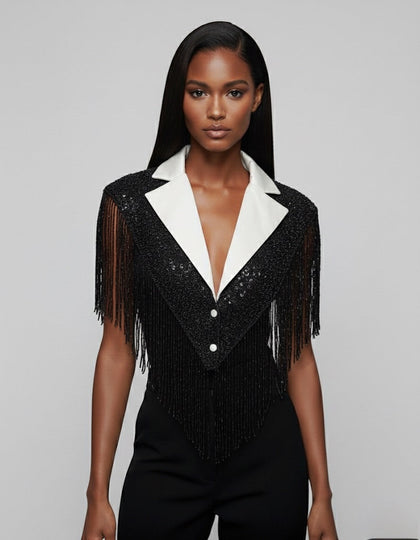
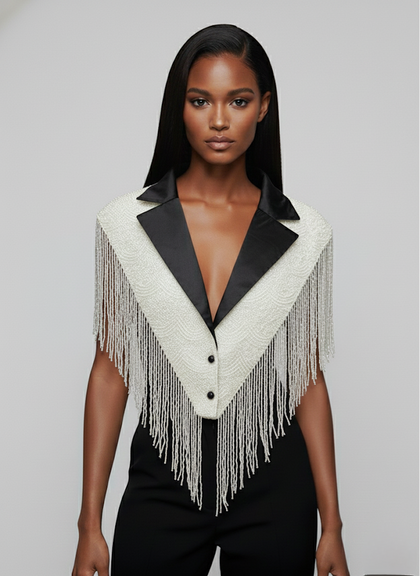
New Orleans Carnival is the most beaded fashion tradition in the United States — not as a ranking judgment but as a statement of material fact. Between the Mardi Gras Indian suits sewn over entire years, the Krewe float-rider costumes that have shaped American Carnival imagery since the 19th century, and the second-line parade regalia worn by social aid clubs, more individually-sewn beads are set into garments in New Orleans every year than in any other American city's fashion ecosystem. This article is a respectful context for that tradition — the one the Krewe Love Collection sits adjacent to. Not an ethnography; not a claim of affiliation; a reference read for customers who want to understand the aesthetic lineage their cape is a quiet participant in.
The three beading traditions of NOLA Carnival
New Orleans Carnival's beading isn't one tradition — it's three overlapping communities of craft, each with distinct origins, techniques, and cultural meaning.
- Mardi Gras Indian suits — a Black Indian masking tradition that emerged in the mid-19th century, carried forward by specific tribes (Creole Wild West, White Cloud Hunters, Wild Magnolias, Fi-Yi-Yi, Golden Eagles, Young Masai Hunters, others). Each suit is hand-beaded and hand-sewn across 6–12 months, retired at the end of Carnival, and replaced annually.
- Krewe costume — the float-rider and royal-court regalia of the Carnival krewes (Rex, Comus, Zulu, Endymion, Bacchus, Muses, Nyx, and dozens of others). Commercially produced at scale; commissioned through Carnival costume houses that have operated in NOLA since the 1870s.
- Second-line / social aid club regalia — the beadwork and sash-work worn by members of Black Social Aid and Pleasure Clubs (Zulu, Olympia, Treme Sidewalk Steppers, Black Men of Labor, Single Ladies) on second-line parades. A parallel tradition to Mardi Gras Indians, tied to Black New Orleans community life year-round.
All three traditions use beading differently. Mardi Gras Indian suits are the most labor-intensive — a single "Big Chief" suit can contain 100,000+ individually-sewn beads representing hundreds of work-hours. Krewe costume is often machine-produced but includes hand-finished beaded elements. Second-line regalia sits in between.
Mardi Gras Indian tradition — respect and boundaries
The Mardi Gras Indian tradition is a specific cultural inheritance of Black New Orleans. It emerged in the mid-1800s as a masking practice blending West African, Afro-Caribbean, and Indigenous American cultural elements — historians trace the tradition partly to the cooperation between escaped enslaved Africans and Indigenous peoples who sheltered them. The annual suit-building cycle, the call-and-response chants ("Iko Iko," "Jock-a-mo Fee-Nah-Ney"), the hierarchy of positions within each tribe (Big Chief, Spy Boy, Flag Boy, Wildman), and the territorial tradition of tribes encountering each other on Mardi Gras morning — all of these are living cultural practices belonging to specific communities and families.
The academic and archival work on Mardi Gras Indian tradition — the Historic New Orleans Collection, the Backstreet Cultural Museum, the Smithsonian Folkways recordings, and Shane Lief and John McCusker's 'Jockomo: The Native Roots of Mardi Gras Indians' (2019) — treat the suits as both art and ceremonial regalia. Many Indians actively resist having their imagery commercialized, and tribes have publicly objected to fashion brands copying suit designs without permission.
What this means for the fashion industry, including ours: aesthetic homage is possible; aesthetic appropriation is not. A couture cape with plume, feather, and bead detailing references the broader aesthetic world of New Orleans Carnival without copying a specific Mardi Gras Indian suit. A cape that reproduced the specific apron-panel structure, the beaded crown, or the family-specific color of a known suit would cross that line. L'Jai Amor's Krewe Love pieces fall into the first category — aesthetic reference, not reproduction.
Krewe costume — the commercial lineage
The commercial Carnival costume trade has operated continuously in New Orleans since the 1870s, when the first Carnival-specific costume houses opened to service the krewes' float-rider needs. Today, a small number of NOLA costume ateliers supply the royal-court regalia for the major krewes — Rex, Comus, Zulu, and others — in an annual production cycle.
These costumes are hand-beaded at a production pace no other US fashion category matches. A typical krewe queen's gown contains 20,000–60,000 beads. The masks, capes, and headdresses add another several thousand each. Multiply by the dozens of royal-court members per krewe, the hundreds of float-riders, and the overlap of dozens of krewes — annual NOLA Carnival production is the single largest output of hand-beaded garments in the United States. This is the scale of the tradition.
The commercial costume trade is separate from the Mardi Gras Indian tradition — different craftspeople, different designs, different customers, different spaces. They share the city and the date but not the cultural inheritance.
Second-line regalia
Second-line parades are processional events organized by Black Social Aid and Pleasure Clubs throughout the year. Originating from 19th-century mutual aid societies that provided burial insurance and financial support to Black New Orleanians excluded from white institutions, the SAPCs today continue as community organizations that throw public parades. Each club's annual parade features members in elaborately-beaded sashes, vest panels, umbrellas, and fans — second-line regalia.
The SAPC beading tradition is distinct from both Mardi Gras Indian suits and krewe costume — it operates year-round (not just Carnival), its craft techniques draw from both traditions but have their own vocabulary (especially around umbrella and fan work), and it is tied specifically to Black New Orleans social history. Scholars like Rachel Breunlin and the Neighborhood Story Project have documented these traditions in detail.
The cape, aesthetically
Where does a couture cape fit in this landscape?
The cape is not a traditional NOLA Carnival garment in the sense that Mardi Gras Indian suits or krewe gowns are. It's adjacent. It's a modern fashion form that borrows the aesthetic vocabulary of Carnival beading — the use of crystal, sequin, pearl, fringe, plume, feather — and translates it into a single garment that can be worn at a ball, a wedding, a gala, a red carpet, or a Mardi Gras event without being a tradition-specific regalia.
For the Mardi Gras ball context, a cape is specifically appropriate because ball dress codes (white tie, strict formal) require guests to wear gown-level formalwear. A beaded cape sits cleanly inside that dress code while carrying Carnival visual energy.
For non-Carnival contexts (Derby, red carpet, bridal), the beaded cape carries NOLA aesthetic DNA without being a NOLA tradition — which is fine. The aesthetic lineage is the point.
The quick version
- New Orleans Carnival comprises three overlapping beading traditions: Mardi Gras Indian suits, commercial krewe costume, and second-line / SAPC regalia.
- Mardi Gras Indian suits are a Black masking tradition with specific families and tribes. Aesthetic homage is possible; reproducing specific suits is not.
- The commercial Carnival costume trade has operated in NOLA since the 1870s and produces more hand-beaded garments annually than any other US fashion category.
- Second-line regalia is a parallel, year-round tradition of Black Social Aid and Pleasure Clubs.
- A couture cape is adjacent to these traditions — it borrows the aesthetic vocabulary (crystal, plume, fringe, bead) without being a tradition-specific regalia.
- L'Jai Amor's Krewe Love Collection sits in this adjacent space as a designer cape house led by a New Orleans-based Black woman, Paige Alexander.
- For deeper reading: The Historic New Orleans Collection, the Backstreet Cultural Museum, the Louisiana State Museum, and Shane Lief + John McCusker's 'Jockomo' (2019).
Related reading
- How to wear a statement cape — five occasions, five silhouettes.
- Care + storage for hand-beaded garments — the atelier protocol.
Shop the atelier
- Big Chief Plume Cape · $175
- Cherry Peacock Cape · $120
- Bordeaux Fringe Cape · $120
- Full L'Jai Amor catalog
References
- The Historic New Orleans Collection — Mardi Gras Archive — The Historic New Orleans Collection (accessed 2026-04-24)
- Smithsonian Folkways — Mardi Gras Indians documentation — Smithsonian Folkways Recordings (accessed 2026-04-24)
- Louisiana State Museum — Carnival Collection — Louisiana State Museum (accessed 2026-04-24)
- Backstreet Cultural Museum — Mardi Gras Indian Documentation — Backstreet Cultural Museum, New Orleans (accessed 2026-04-24)
Discover more from L'Jai Amor or browse the full L'Jai Amor collection.
Frequently asked
What does "Why New Orleans Carnival Is the Most Beaded Fashion Tradition in the US" cover?
This piece walks through the topic, context, and practical implications laid out in the article body above — focused on giving you a clear, sourced read rather than a quick listicle. Use it to deepen your understanding of the brand, category, or product family discussed.
Who is this article written for?
Readers shopping the brand or category covered, plus curious browsers researching independent makers stocked at Curated Sense. Both casual shoppers and trade buyers will find the same source-linked perspective.
How does Curated Sense vet the brands featured in journal articles?
Every brand in our journal has been onboarded directly: live inventory sync with the brand's own catalog, links back to the maker's own .com, and quality checks against return-rate, fulfillment-time, and customer-message-volume thresholds. We don't run sponsored placements in our journals.
Where can I shop the products discussed in this article?
Open the brand's collection or sub-collection page linked above to see current stock. Each product card opens a full Curated Sense product page with sizing, materials, the maker's own description, and the brand's live shipping policy.