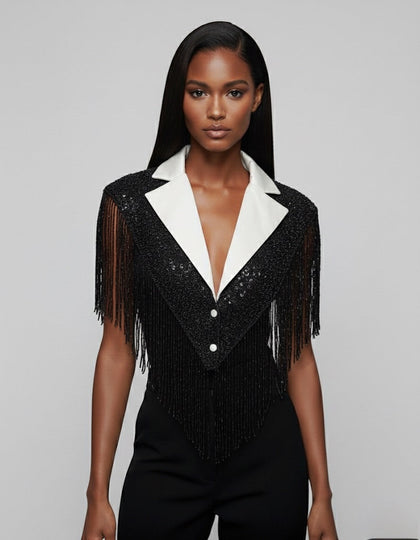
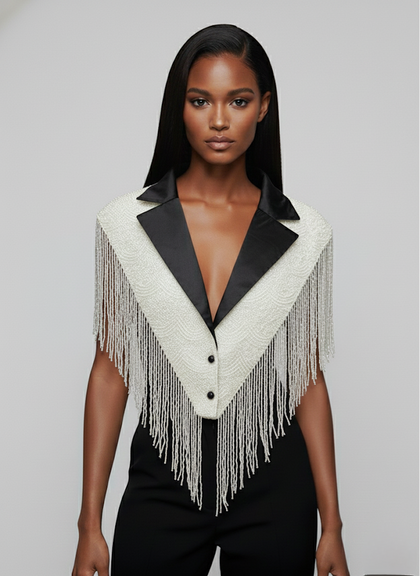
A statement cape is the single most leverage-heavy garment in a contemporary wardrobe. One piece, thrown over whatever you were already wearing, creates full entrance presence — the work done by a well-cut cape is work that would otherwise require a tailored gown, an evening coat, a beaded jacket, and a statement bag combined. This article covers the five occasions where a cape out-performs every other outerwear option, the silhouette-by-silhouette pairing logic, and the base-layer decisions that make or break the finished look. Educational — not stylist consultation.
Why the cape works
The cape is structurally unlike any other garment. It doesn't hug the torso — it drapes from the shoulder-line. This means two things: (1) the shoulder becomes the garment's anchor, which is why a well-cut cape looks regal rather than shrugged-on; and (2) the base layer underneath becomes almost irrelevant to the silhouette. A cape over a silk slip reads the same from across a room as a cape over a fitted blazer and pants.
This is the leverage. Most outerwear flattens the base layer (a coat hides the dress, a wrap pulls tight) — the cape frames it. The base layer is visible in the front opening and below the hem. You're styling a framed outfit.
Occasion 1 — The gala / black-tie
The highest-leverage occasion for a cape. Black-tie dress code calls for a floor-length gown and formal evening coat — but a floor-length gown requires an evening coat OR a wrap, and both of those are functional (cold shoulders, transit warmth) rather than aesthetic. A statement cape replaces both.
The silhouette that works best: fringe-front, Bordeaux-red or noir, floor-length or mid-shin. The cape becomes the garment; the gown underneath becomes the lining. Fringe and bead-work catch the light during the photo line.
What to wear underneath: a clean-silhouette slip dress or fitted column gown with minimal embellishment. The cape does the drama; the dress grounds it.
What to avoid: layering a beaded cape over a beaded gown. Two loud voices flatten each other. One beaded piece per outfit — the cape is it.
Occasion 2 — Bridal / wedding
Capes have a long bridal history. The Victoria & Albert Museum's textile archive traces cape-adjacent bridal outerwear (mantles, pelisses, cloaks) back to 18th-century European weddings. The modern bridal cape emerged as a replacement for the heavy Victorian cloak — same dramatic entrance, 1/10 the weight.
Best context: the send-off moment, the reception second-look, winter weddings, or outdoor ceremonies where a traditional veil won't sit still.
Silhouettes that work: ivory or blush with pearl or crystal beading (not gold — gold reads away from bridal); floor-length for send-off photography; cropped for the reception.
What to wear underneath: the dress. The cape is an addition, not a replacement. Many brides commission a cape in addition to the gown specifically for the send-off moment.
Timing: L'Jai Amor's bespoke bridal intake runs 6–10 weeks. Ordering earlier than later.
Occasion 3 — Mardi Gras ball / carnival
This is the cape's native habitat. New Orleans Mardi Gras balls (Zulu, Endymion, Bacchus, Rex) have hard dress codes — white tie for most, with an implicit expectation that guests bring their own interpretation of carnival imagery. A beaded cape is the single most Mardi-Gras-appropriate outerwear piece a woman can wear.
Silhouettes that work: plume, peacock, fringe, metallic-beaded. This is the one occasion where more is more. Feather and plume detailing is specifically appropriate — these references go back to Mardi Gras Indian and Krewe costume traditions that predate modern couture.
What to wear underneath: black column dress or floor-length black slip. The cape provides all the color.
Important cultural note: Mardi Gras Indian suits are a specific cultural tradition of Black masking Indians with deep generational and ceremonial meaning. Wearing a plume cape is aesthetic homage, not a claim of tribal affiliation. L'Jai Amor's Krewe Love line sits adjacent to this tradition as a respectful aesthetic reference, not a reproduction.
Occasion 4 — Kentucky Derby / Royal Ascot
The Kentucky Derby's official dress code is less strict than people assume — the emphasis is on "Derby attire," which means outfits matched to a formal hat. The cape works here specifically because it gives you volume below the hat line without competing with the hat for visual attention.
Silhouettes that work: printed, fringed, floral-beaded, or solid-color with contrasting trim. Pastel palettes (cherry, bordeaux, ivory, peacock) over a simple column dress or fit-and-flare.
What to wear underneath: a knee-length dress (Derby is seated for long stretches; floor-length catches on chairs and spills). Closed-toe or pointed-toe shoes (the infield is not the red carpet).
Hat pairing rule: the cape and the hat shouldn't share a color. If the hat is coral, the cape is cream. If the hat is black-and-white, the cape is any single color.
Occasion 5 — Red carpet / awards night
The red carpet is a longer-form event than most people realize. Arrival + step-and-repeat + interviews + seating + post-show can run 6+ hours. A cape lets a performer or presenter own the arrival moment and be comfortable once seated inside.
Silhouettes that work: metallic, monochrome, cascading. Stylist Emma Trask has used cape-layered looks on Carrie Underwood's Las Vegas residency to create multi-layered stage entrances — the outer cape comes off mid-performance to reveal the inner garment.
What to wear underneath: fitted jumpsuit, beaded column gown, or two-piece structured ensemble. The cape is the "cover" that becomes the "reveal."
Wear time: if the cape has a closure at the neck, plan to take it off for seated dinner portions. A well-made cape hangs cleanly from a chair-back.
The five silhouettes, mapped
| Occasion | Silhouette | Color family | Underneath |
|---|---|---|---|
| Gala / black-tie | Floor-length fringe | Noir, Bordeaux, gold | Column gown, slip |
| Bridal | Pearl, crystal | Ivory, blush, champagne | The wedding gown |
| Mardi Gras / carnival | Plume, peacock, fringe | All colors + metallic | Black column |
| Derby / Ascot | Print, solid, fringe | Pastels + brights | Knee-length dress |
| Red carpet | Cascade, metallic | Metallic, mono | Jumpsuit, column |
The one thing never to do
Do not dry-clean a hand-beaded cape unless the cleaner has verified hand-beaded-garment experience. Most dry cleaners run an agitation cycle that loosens thread-knotted beads over time. Cumulative dry-cleaning is the single biggest cause of bead loss on couture capes. See the atelier journal's care protocol for the correct approach — hang, air, spot-treat, only dry-clean through a specialist.
The quick version
- A cape drapes from the shoulder, frames the base layer, and replaces 3–4 other garments (coat + wrap + statement jacket + bag).
- Five prime occasions: gala, bridal, Mardi Gras ball, Derby/Ascot, red carpet.
- Match the cape's color to the occasion (noir for gala, ivory for bridal, plume for carnival, pastel for Derby, metallic for red carpet).
- The base layer should be simpler than the cape. One loud voice per outfit.
- Cape + hat: never the same color. Hat dominates; cape complements below the neckline.
- L'Jai Amor's two collections map roughly to: Krewe Love = gala + carnival + bridal send-off; Power Play = red carpet + executive events + keynote stages.
- Never dry-clean a hand-beaded cape without specialist verification.
Related reading
- Care + storage for hand-beaded garments — the atelier protocol.
- Why New Orleans carnival is the most beaded fashion tradition in the US.
Shop the capes
References
- Emily Post Institute — Formalwear Etiquette — Emily Post Institute (accessed 2026-04-24)
- Kentucky Derby Official Dress Code — Churchill Downs · Kentucky Derby (accessed 2026-04-24)
- Victoria & Albert Museum — History of the Cape as Garment — Victoria and Albert Museum, London (accessed 2026-04-24)
- Council of Fashion Designers of America — Red Carpet Dress Code References — CFDA (Council of Fashion Designers of America) (accessed 2026-04-24)
Discover more from L'Jai Amor or browse the full L'Jai Amor collection.
Frequently asked
What does "How to Wear a Statement Cape — Five Occasions, Five Silhouettes" cover?
This piece walks through the topic, context, and practical implications laid out in the article body above — focused on giving you a clear, sourced read rather than a quick listicle. Use it to deepen your understanding of the brand, category, or product family discussed.
Who is this article written for?
Readers shopping the brand or category covered, plus curious browsers researching independent makers stocked at Curated Sense. Both casual shoppers and trade buyers will find the same source-linked perspective.
How does Curated Sense vet the brands featured in journal articles?
Every brand in our journal has been onboarded directly: live inventory sync with the brand's own catalog, links back to the maker's own .com, and quality checks against return-rate, fulfillment-time, and customer-message-volume thresholds. We don't run sponsored placements in our journals.
Where can I shop the products discussed in this article?
Open the brand's collection or sub-collection page linked above to see current stock. Each product card opens a full Curated Sense product page with sizing, materials, the maker's own description, and the brand's live shipping policy.