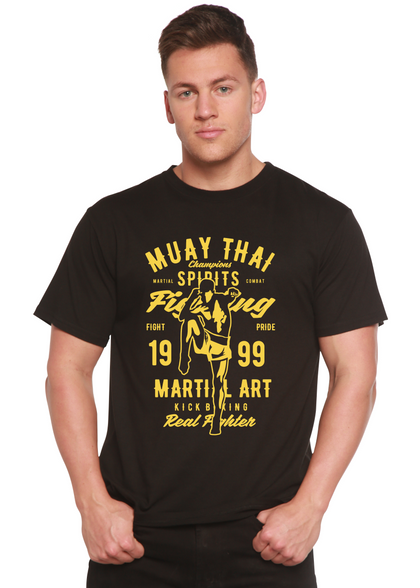
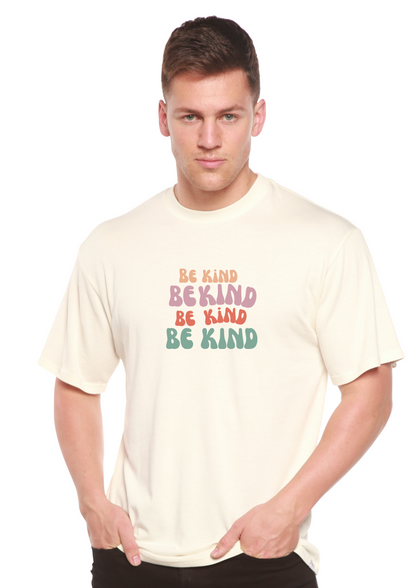
When a hangtag reads bamboo viscose, what's on the body is technically a regenerated cellulosic fiber: cellulose extracted from bamboo pulp, then chemically reborn as a long fiber through the viscose process. That distinction — natural source, chemical regeneration — is what the Federal Trade Commission spent the better part of a decade enforcing. This article walks through the actual chemistry, the FTC labeling rules that came out of it, and the meaningful differences between bamboo viscose, modal, lyocell, and rayon-from-cotton-pulp.
Step 1: where 'bamboo' actually starts
The clothing-grade bamboo is almost always Moso bamboo (Phyllostachys edulis) — the largest woody bamboo species in the world, native to the Sichuan and Hunan regions of central China. Moso reaches mature harvest height (15–25 m) in 4–5 years, then regenerates from the rhizome (root system) without replanting. Per the International Network for Bamboo and Rattan (INBAR) 2018 study, a managed Moso grove can yield continuous fiber harvest for 70+ years from a single planting, sequestering an estimated 18 tonnes of CO₂ per hectare per year — about 4× the rate of a conventional cotton field of the same area.
Step 2: the alkali steep (mercerization)
Cut bamboo stalks are mechanically crushed and chipped, then steeped in a 17–20% sodium hydroxide (NaOH) solution at room temperature for 1–3 hours. This step — called mercerization in the textile-chemistry literature — swells the cellulose fibers and breaks the hemicellulose linkages that bind them to lignin. The result is alkali cellulose: a sodium-cellulose intermediate that can be further chemically processed. This is the same first step used in producing rayon from any wood-pulp source (eucalyptus for Tencel, beech for modal, pine for standard rayon).
Step 3: xanthation — the carbon disulfide step
Alkali cellulose is treated with carbon disulfide (CS₂) at 25–30 °C for 2–3 hours. This produces sodium cellulose xanthate, a soluble cellulose derivative that can be dissolved into a viscous orange liquid called viscose (hence the fabric name). This is the chemistry step environmental advocates flag — carbon disulfide is a hazardous chemical with documented neurological effects on workers in poorly-controlled facilities. Modern OEKO-TEX-certified viscose mills run closed-loop CS₂ recovery at 95%+ efficiency per ZDHC (Zero Discharge of Hazardous Chemicals) Foundation 2023 industry data; older mills don't, which is why third-party certification matters.
Step 4: dissolution into the spinning bath
Sodium cellulose xanthate is dissolved in dilute NaOH solution to produce a yellow-orange viscose dope. The dope is filtered to remove undissolved particles, then aged for several hours (this controls fiber strength). The final viscose is forced through a spinneret — a metal plate with thousands of holes 50–100 micrometers in diameter — into a coagulation bath of dilute sulfuric acid (H₂SO₄), sodium sulfate, and zinc sulfate. The acid neutralizes the xanthate and regenerates the cellulose as a continuous filament fiber.
Step 5: filament to staple to fabric
The regenerated cellulose filament is washed in successive baths to remove residual chemicals, bleached for color uniformity, and finally cut into staple-length fibers (38–60 mm for clothing-grade viscose). Staple fibers are spun into yarn — typically blended with organic cotton (70/30 is the most common ratio) for added strength and dimensional stability. The yarn is then circular-knit into jersey, interlock, or rib fabric on industry-standard knitting machines. Spun Bamboo®'s flagship blend, on most of their men's tees and lounge program, is 70% bamboo viscose / 30% organic cotton.
Why it's NOT the same as bamboo linen
There's a parallel category, called bamboo linen (or mechanically-processed bamboo), where the bamboo fibers are extracted mechanically without the viscose process — crushed, retted, and combed similar to flax linen. This produces a coarser, more rustic fabric. It's chemically more honest (no xanthation step) but commercially rare because the fibers are short and the resulting fabric has limited drape. Per FTC guidance, bamboo linen is the only bamboo-derived fabric that can legitimately be labeled natural bamboo; everything else, including all common bamboo clothing, must be labeled rayon or viscose with the bamboo-source qualifier.
The FTC enforcement record (2009–2015)
In 2009, the Federal Trade Commission settled four parallel cases against major retailers — FTC v. Macy's, Sears, Bed Bath & Beyond, and Leon Max — for misrepresenting rayon-from-bamboo fabric as 100% bamboo, antibacterial, and biodegradable. The combined civil penalty was $1.26 million. The agency followed up in 2013 and 2015 with warning letters to 78 additional retailers under the same framework. The legal basis is 16 CFR Part 303 — the Textile Fiber Products Identification Act — which requires the FTC-recognized generic fiber name on every garment label. The compliant labels are rayon from bamboo, viscose from bamboo, or rayon (from bamboo); the noncompliant label is bamboo alone or 100% bamboo.
How bamboo viscose differs from modal
Modal is a high-wet-modulus (HWM) version of viscose, originally patented by Lenzing AG in 1962 (Austrian Patent 264,415). The chemistry is similar to standard viscose, but the regeneration bath uses dilute sulfuric acid at lower concentration plus controlled stretching of the filament during regeneration. The result: modal fibers retain ~80% of their dry strength when wet, vs. 50–60% for standard viscose. Modal is dimensionally more stable through wash cycles (less shrinkage, less pilling). Most modal in 2026 is made from FSC-certified beech wood pulp, not bamboo — though bamboo HWM viscose exists (Lenzing markets it under the TENCEL™ Modal brand for some applications). Spun Bamboo®'s standard program is conventional bamboo viscose, not HWM modal.
How bamboo viscose differs from lyocell (Tencel)
Lyocell — best known by the Lenzing trademark TENCEL™ Lyocell — uses a fundamentally different solvent. Instead of the NaOH-CS₂-H₂SO₄ chain of viscose, lyocell dissolves cellulose directly in N-methylmorpholine N-oxide (NMMO), a non-toxic amine oxide that's recovered at 99%+ efficiency in closed-loop production. The result is a cleaner production process, slightly different fiber properties (more fibrillation, slightly higher dry/wet strength), and a higher price point. Lyocell from bamboo pulp does exist, but is not the standard for clothing-grade bamboo fabric. Most consumer bamboo clothing — including Spun Bamboo®'s catalog — is conventional viscose, not lyocell.
Cellulose source matters less than process control
From a fiber-property standpoint, the cellulose source matters less than the process. Beech-pulp viscose (modal), eucalyptus-pulp viscose (Tencel/lyocell), pine-pulp viscose (standard rayon), and bamboo-pulp viscose (most bamboo clothing) all start from C₆H₁₀O₅ cellulose monomer units. The differences come from (a) which solvent system is used (viscose CS₂ vs. lyocell NMMO), (b) what stretching/regeneration profile (HWM vs. standard), (c) what's blended in for spinning, and (d) what process controls are in place at the mill. A well-run viscose mill produces cleaner cloth than a badly-run lyocell mill. The certifications worth checking — for any cellulosic fiber from any source — are OEKO-TEX Standard 100 (finished-garment chemistry), FSC chain-of-custody (forest source), and ZDHC mill audit (process emissions).
Spun Bamboo® on the spec sheet
On the Spun Bamboo® product pages, the standard program reads: 70% bamboo viscose / 30% organic cotton for the men's tees and most of the lounge program; 95% bamboo viscose / 5% spandex for the underwear lines (which need recovery stretch); and 85% bamboo viscose / 12% nylon / 3% spandex for the sock program (where reinforcement and arch compression matter). Every blend ratio is FTC-compliant, every garment carries the viscose from bamboo generic-fiber name on the inside-collar label, and the catalog operates under USPTO Reg. No. 3,621,879 — the Spun Bamboo® registered trademark filed in 2007.
What this means for the buyer
Bamboo viscose is a legitimate cellulosic fiber with real environmental advantages over conventional cotton (lower water footprint, no insecticide, higher CO₂ sequestration in the source plant). It's not a magical 'natural fiber' — it goes through the same viscose chemistry as rayon-from-wood — but the bamboo source itself is meaningfully more sustainable than cotton in the upstream cultivation step. A buyer evaluating a bamboo-clothing brand in 2026 should look for three signals: (1) the FTC-compliant fiber-name label (viscose from bamboo, not 100% bamboo), (2) third-party finished-garment certification (OEKO-TEX Standard 100 at minimum), and (3) supply-chain transparency on where the bamboo pulp is sourced and which mill processes it. Spun Bamboo®, founded in 2007 and trademark-registered in 2009, is one of the brands that has met all three since before the 2009 FTC enforcement wave.
Discover more from Spun Bamboo or browse the full Spun Bamboo collection.
Frequently asked
What does "Bamboo Viscose, Chemically Explained: From Phyllostachys edulis to a Soft Tee — and Why It's Not the Same as Rayon, Modal, or Lyocell" cover?
This piece walks through the topic, context, and practical implications laid out in the article body above — focused on giving you a clear, sourced read rather than a quick listicle. Use it to deepen your understanding of the brand, category, or product family discussed.
Who is this article written for?
Readers shopping the brand or category covered, plus curious browsers researching independent makers stocked at Curated Sense. Both casual shoppers and trade buyers will find the same source-linked perspective.
How does Curated Sense vet the brands featured in journal articles?
Every brand in our journal has been onboarded directly: live inventory sync with the brand's own catalog, links back to the maker's own .com, and quality checks against return-rate, fulfillment-time, and customer-message-volume thresholds. We don't run sponsored placements in our journals.
Where can I shop the products discussed in this article?
Open the brand's collection or sub-collection page linked above to see current stock. Each product card opens a full Curated Sense product page with sizing, materials, the maker's own description, and the brand's live shipping policy.